

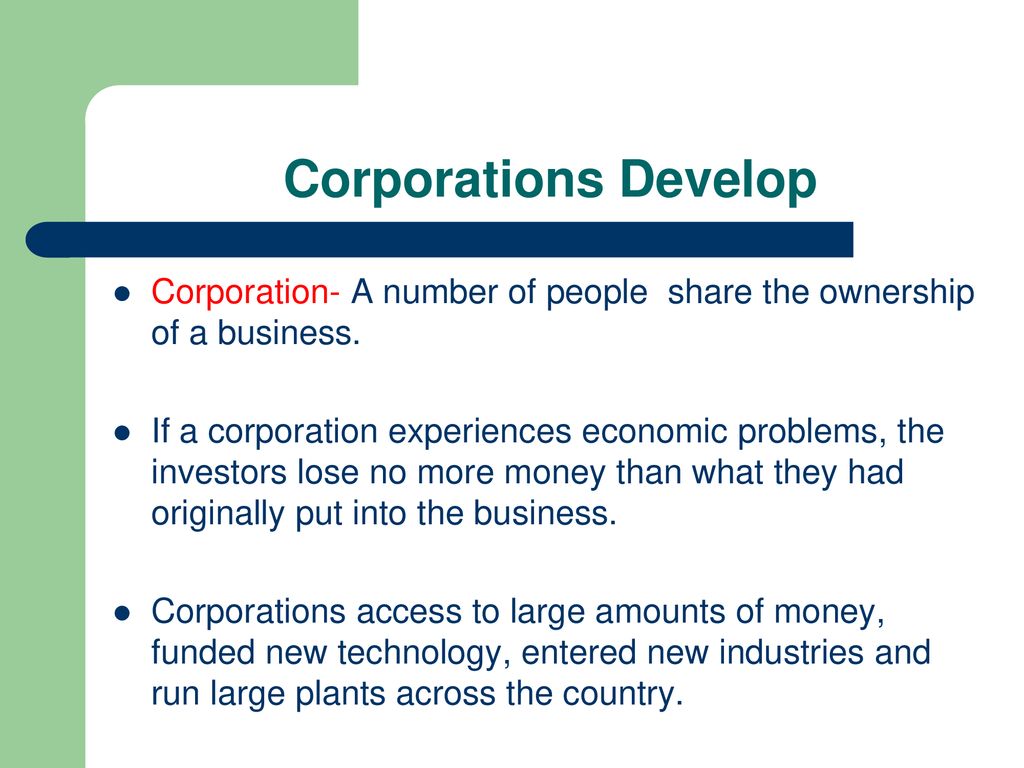
A service corporation is a sort of entity that is identified as separate from its owners, who are called shareholders. This separation is vital as it gives the shareholders with limited responsibility, meaning their personal properties are protected from the corporation's debts and lawsuits. Firms are developed under the legislations of a particular state and can contain one or even more individuals. Establishing a firm involves a number of steps consisting of the filing of an "Articles of Unification" with the appropriate state authority, and the creation of laws that govern the corporation's procedures. Among the defining attributes of a firm is its ability to provide stock, which can be an essential tool for raising funding. Investors can spend cash in the firm and in return, obtain a symmetrical ownership in the kind of stocks.
As soon as developed, a firm must follow a number of regulatory requirements, including holding normal meetings, maintaining detailed documents, and sending yearly reports. These requirements aid make certain openness and liability, securing the interests of both the investors and the public. The structure of a firm typically consists of a board of police officers and supervisors. The board of directors, elected by the investors, oversees the significant policies and decisions of the corporation and selects the officers that handle the daily operations. This hierarchical framework is essential as it assists in marking duties and making certain effective administration. Additionally, corporations undergo business tax obligations on their revenues, and they must adhere to both state and government laws which can differ widely depending upon the market and place of the firm. Comprehending these laws and successfully taking care of a firm can result in significant growth and earnings.
Understanding the Framework and Function of Company Companies
Organization corporations, as formal entities, play a pivotal role in the contemporary economy by unifying efforts and sources to achieve usual objectives, largely generating earnings for their investors. These entities are legitimately identified and supply a framework where service activities can be performed successfully and with restricted obligation for the owners. At the heart of a company is the principle of restricted liability, which implies that the individual possessions of shareholders are shielded; they are just responsible for their investment in the business. This essential characteristic not only motivates investment and risk-taking yet additionally helps with the pooling of big amounts of capital necessary for major enterprises.
Strategic Relevance of Business Corporation Structuring
Recognizing the calculated importance of structuring a company company effectively is important for lasting success and durability in the competitive market landscape. Among the crucial elements in this process is establishing one of the most helpful legal structure that aligns with the firm's objectives and functional needs. Whether a company go with a C firm, S firm, or a Minimal Responsibility Business (LLC), each option features distinctive tax obligation effects, obligation problems, and flexibility in administration and possession that can exceptionally affect the corporation's future. Founders must consider just how these frameworks can influence every little thing from drawing in financial investment to the ease of future company growths or mergings. Furthermore, a well-thought-out corporate framework can boost reliability with stakeholders and offer a strong structure for developing clear lines of authority and duty. This is especially important in larger companies where the delegation of roles and ordered coverage systems ensure effectiveness and quality in decision-making procedures. In addition, critical structuring also permits corporations to a lot more effectively manage risks by plainly defining obligation and safeguarding personal assets of the owners from business financial debts or suits. Ultimately, a wisely made corporate structure is not just a lawful requirement however a calculated device that can be made use of to utilize affordable benefit, adapt to market modifications, and pursue long-term growth purposes with better agility and emphasis.
Strategic Management and Corporate Governance in Company Corporations
In modern business companies, critical management and business governance play crucial functions fit the organization's instructions and ensuring its conformity with lawful policies and honest criteria. Strategic management refers to the methodical preparation, evaluation, and implementation of actions intended at protecting a competitive advantage on the market. It includes a deep understanding of the marketplace dynamics, customer actions, and technological advancements to make enlightened decisions that steer the corporation in the direction of long-term earnings and sustainability. Corporate governance, on the other hand, incorporates the systems, processes, and relationships whereby firms are controlled and directed. It concentrates on balancing the rate of interests of a business's numerous stakeholders, such as investors, monitoring, clients, vendors, financiers, government, and the neighborhood. While calculated administration is worried with the operational aspects of a company, business governance deals with the framework within which these procedures are carried out, ensuring openness, accountability, and fairness in company tasks. With each other, these two disciplines make sure that a firm not just prospers in an affordable environment yet additionally keeps a robust honest stance that reinforces its credibility and longevity in the market. The combination of tactical administration and business governance has ended up being progressively relevant in the electronic age, where quick technological changes can dramatically change affordable landscapes and consumer assumptions, necessitating nimble responses and foresighted governance methods. This harmony is crucial not only for accomplishing company objectives however additionally for cultivating a company society that focuses on honesty and social obligation.
Strategic Monitoring and Competitive Benefit in Service Firms
In the vibrant sphere of service, corporations face the constant difficulty of preserving a competitive side to make certain sustainable growth and profitability. Strategic monitoring arises as a pivotal system, equipping companies to synergize their resources, capacities, and core competencies to outperform competitors. This involves not just the formulation however additionally the execution of forward-thinking strategies that are lined up with the firm's long-term purposes and the unstable nature of market demands. A considerable aspect of strategic management is the evaluation of exterior market conditions, consisting of rival activities, technical developments, and governing adjustments, which can considerably alter affordable landscapes. By involving in how to check if a company is legitimate in canada , businesses are much better furnished to anticipate changes and adapt their methods accordingly. Importantly, the role of technology in business method can not be underrated. Companies that leader brand-new technologies, organization models, or market methods can establish sector criteria, leaving competitors to follow in their wake. Additionally, the growing of a solid corporate culture that embraces modification and fosters development is crucial for the effective application of strategic efforts. In essence, the proficient handling of calculated management and the pursuit of technology serve as cornerstone components that enable services to protect a competitive advantage and navigate the complexities of the global market.